
Why Most Digital Transformation Programs Stall After Year 2
Digital transformation is not a journey with a predictable finish line. It is an ongoing shift in how a business creates value. But across industries, one specific inflection point consistently emerges in research and practice: the second year of a program.
At this point, efforts either start yielding measurable strategic value or they begin a slow slide into tactical irrelevance, plateauing instead of scaling. Understanding why this happens is critical for executives who want digital efforts to drive real business performance beyond mere technology adoption.
Digital Transformation Is Widespread, But Impact Remains Elusive
Digital transformation is now a near-universal priority at the executive level.
- Nine in ten C-level and senior leaders say their organizations have pursued at least one large-scale digital transformation in the past two years. (McKinsey)
- Global spending on digital transformation initiatives reached approximately $2.58 trillion in 2025 and is projected to grow to about $3.9 trillion by 2027 according to industry market research. (DOIT)
Despite this level of commitment and investment, results remain mixed. Research shows that only about 48 percent of digital initiatives meet or exceed their intended business outcome targets (Gartner). The disconnect between effort and impact is well known. What is less often examined is when this disconnect becomes most visible.
Why Businesses Hit Their Breaking Point In Year Two
Across industries and platforms, research points to a consistent pattern: digital transformation rarely collapses in year two, but this is when it decisively stalls or scales.
The reason is not a single failure mode. It is the convergence of several structural forces that tend to surface at the same time, once initial implementation is complete and early momentum fades.
The table below summarizes the most common drivers of the year-two stall, each of which is examined in detail in the sections that follow.
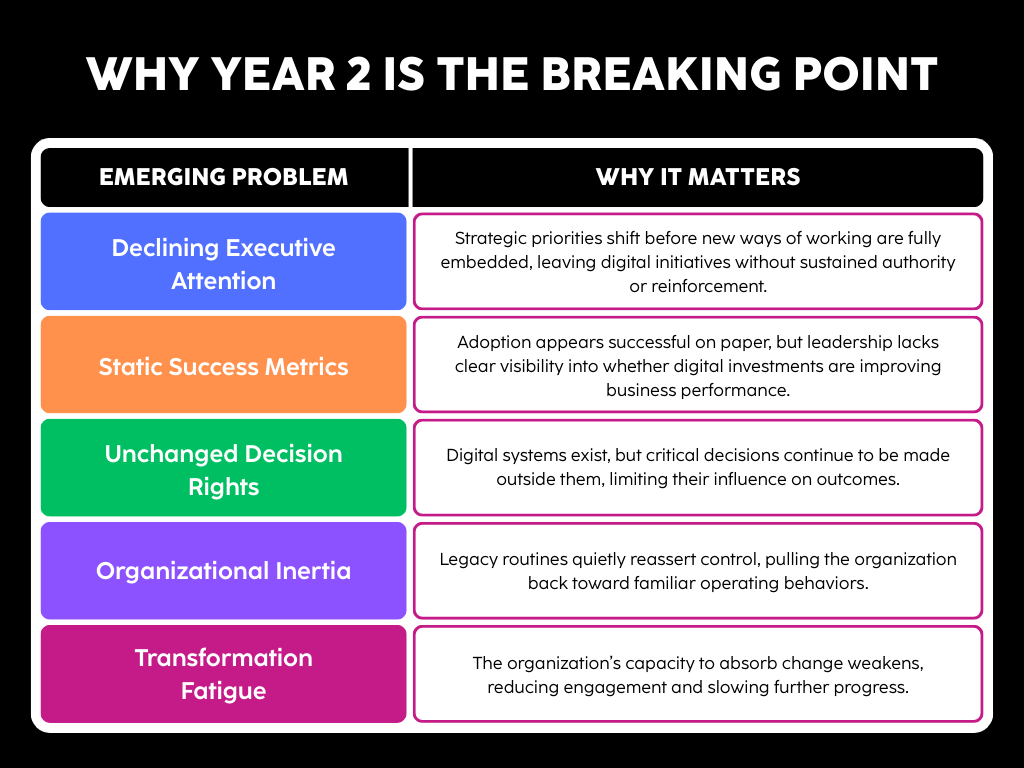
Taken together, these forces explain why the second year consistently marks the point where digital transformations either become part of how the business runs or fade into background infrastructure.
Leadership Attention Declines Before Value Fully Materializes
Sustained transformation requires sustained executive engagement. Yet both industry and academic research indicate that leadership attention often diminishes after the initial implementation phase.
Digital transformation should be treated as a long-term strategic discipline rather than a time-bound initiative. In practice, however, executive focus frequently shifts once early milestones are reached and major delivery risks are resolved. This transition often occurs before the organization has embedded new behaviors and decision-making processes.
Studies on strategic change reinforce that leadership influence extends beyond sponsorship. Long-term success depends on continued reinforcement of governance models, accountability structures, and decision rights. When this reinforcement weakens, typically around the second year, momentum begins to fade.
Measurement Systems Stop Driving the Right Behavior
One of the most consistent contributors to second-year stalls is measurement decay.
Early in a transformation, progress is commonly tracked using operational metrics such as system deployment, user adoption, and process coverage. These KPIs are useful at the outset, but research shows they are poor indicators of long-term business impact.
By the 18-to-24-month mark, many organizations report strong adoption metrics alongside weak performance outcomes. This happens because operational measures such as system usage and process coverage create the appearance of progress, even as the transformation stops shaping how leaders prioritize work, allocate resources, and make decisions.
When organizations rely primarily on activity-based metrics instead of business outcomes, teams are incentivized to sustain usage and compliance rather than drive measurable improvements in revenue growth, cost structure, resilience, or agility. The corrective action is to explicitly tie digital systems to performance management by redefining success metrics around decision quality, cycle time reduction, financial impact, and risk exposure, and then holding leaders accountable for those outcomes through regular operating reviews.
Decision Rights Remain Unchanged
Digital transformation introduces new data, new insights, and new system-driven recommendations. Yet in many organizations, the authority to make decisions does not move with those capabilities.
In the first year of a transformation, this misalignment is easy to overlook. Systems are new, teams are learning, and leaders tolerate exceptions as part of stabilization. By the second year, however, the cost becomes visible.
When decision authority remains anchored in legacy roles and hierarchies, digital systems are reduced to reporting tools rather than engines of execution. Data informs discussions, but it does not determine outcomes. Managers override system recommendations, escalate decisions manually, or revert to experience-based judgment when trade-offs arise. This creates a structural ceiling on value. Even with high system adoption and data quality, the organization cannot scale impact if decisions continue to be made outside the digital workflow. Over time, teams learn that using the system is required, but trusting it is optional.
The second year is when this dynamic hardens. Without explicit reassignment of decision rights to roles, processes, and governance forums that are digitally enabled, transformation stalls at the point where insight should translate into action.
Organizational Inertia Reasserts Itself
Organizational inertia refers to the tendency of established structures, decision rules, incentives, and routines to persist even when new systems and strategies are introduced.
In practice, this means that while digital platforms may be implemented successfully, the underlying operating logic of the organization remains unchanged. Decision authority stays where it has always been. Performance expectations remain tied to legacy measures. Managers and teams continue to rely on familiar processes, even when new digital capabilities are available. Many digital transformations stall not because technology underperforms, but because organizations fail to redesign governance, operating models, and management processes to match their new digital capabilities.
Once early technical challenges are resolved, typically within the first year, these structural mismatches become more visible. Without deliberate changes to decision rights, incentives, and accountability mechanisms, organizations default back to established routines. This reversion is rarely abrupt. Instead, it emerges through workarounds, parallel processes, and declining reliance on digital systems for critical decisions.
By the second year, these patterns are often normalized, making the transformation increasingly difficult to restart or scale. This is why digital transformation ultimately succeeds or fails as an organizational change, not a technology upgrade.
Transformation Fatigue Peaks
Another force that converges around the second-year mark is transformation fatigue, and recent research shows it is both widespread and materially damaging to performance.
50 percent of employees report experiencing transformation fatigue, even as 82 percent agree that digital transformation is essential to remaining competitive (Emergn).
This fatigue is not driven by resistance to change itself. The research shows it is driven by sustained change without visible business payoff. Nearly 45 percent of employees report burnout linked directly to ongoing transformation efforts, and 36 percent say they would consider leaving their roles because of transformation-related stress.
By the second year, this dynamic becomes especially problematic. Early enthusiasm has faded, implementation pressure remains high, and employees are asked to absorb additional waves of change without clear evidence that prior efforts have improved outcomes. As a result, engagement drops, discretionary effort declines, and adoption slows precisely when deeper behavioral change is required.
For executives, this represents a compounding risk. Transformation fatigue reduces organizational capacity at the exact moment when sustained adoption, process redesign, and governance reinforcement are most critical. Without deliberate pacing, prioritization, and clarity on value realization, fatigue becomes a structural barrier that prevents transformation from scaling beyond its initial phase.
Why Year 2 Is The Real Test
When examined together, these patterns reveal a clear convergence of forces around the second year:
- Adoption curves flatten as early gains are exhausted
- Executive attention shifts to competing priorities
- Metrics lose their connection to business value
- Organizational routines reassert control
- Fatigue weakens the organization’s ability to change
What Executives Should Address Before Year 2
Across organizations that successfully push beyond the year-two stall, three interventions consistently make the difference.
First, measurement systems must evolve. Organizations should move beyond adoption metrics and define outcome-based measures tied directly to business performance.
Second, structural change must be embedded. Governance models, decision rights, and incentives must be redesigned so that new ways of working are reinforced by the operating model itself.
Third, leadership engagement must persist. Executive sponsorship must shift from launch oversight to long-term stewardship of outcomes and accountability.
Final Thoughts
The second year of digital transformation is not a milestone. It is a stress test.
Most programs do not fail outright. They stall because organizational systems stop evolving at the same pace as digital investments. That is not a technology problem. It is a business performance and organizational design problem.
If a transformation still looks like project delivery after 18 to 24 months, it is already at risk of becoming expensive infrastructure rather than a source of advantage.
The window to act is narrow. Leaders must act now to hardwire new decision rights, performance measures, and operating rhythms into the business while momentum still exists. Once the stall becomes visible in results, recovery is far more difficult and far more costly.